


Chess History Post #67: A Tale of Two Tals, Part One
All seemed to be going to plan for Bobby Fischer in early 1959. He had defended his US Championship title, become the youngest Grandmaster in history and remained on track for the World Championship by qualifying for the Candidates Tournament, the first fourteen rounds of which were to be played in the Yugoslav town of Bled. It was also to be where Fischer would suffer his first significant setback. He had demonstrated domestic dominance on the American chess scene but had not yet tasted international success. He had won brilliant games but was yet to win brilliant tournaments. Part of the problem was that Fischer’s successful strategy at the Portoroz Interzonal of catching the ‘small-fry,’ simply would not work for the Candidates; there were no ‘small-fry’ left to snag. Instead, Fischer was swimming in a small pond stocked with eight big fish. They consisted of Hungary’s Pal Benko, Iceland’s Fridrik Olafsson and Yugoslavia’s Svetozar Gligoric. The Soviet delegation, reflecting their dominance of international chess, made up half of the field: Paul Keres, Vasily Smyslov, Tigran Petrosian and Mikhail Tal.
The four games between Fischer played against Tal illustrated his psychological shortcomings at this early stage in his career. Tal, a master of mind games, was only 23 years old and well on his way to the World Championship crown. He had won the Portoroz Interzonal and was probably playing the best chess of anyone in the world. When the two met in the thirteenth round, Tal had already won one game from Fischer and the American was struggling. Out of a dozen games he had registered four wins, two draws and six losses. Worse than that, the Soviets seemed to have found Fischer’s Achilles heel: the Caro Kann Defence. In the three games that Fischer’s favoured e4 had been met with c6, he had drawn with Smyslov, lost a gruelling encounter to Petrosian and been completely crushed by Keres.
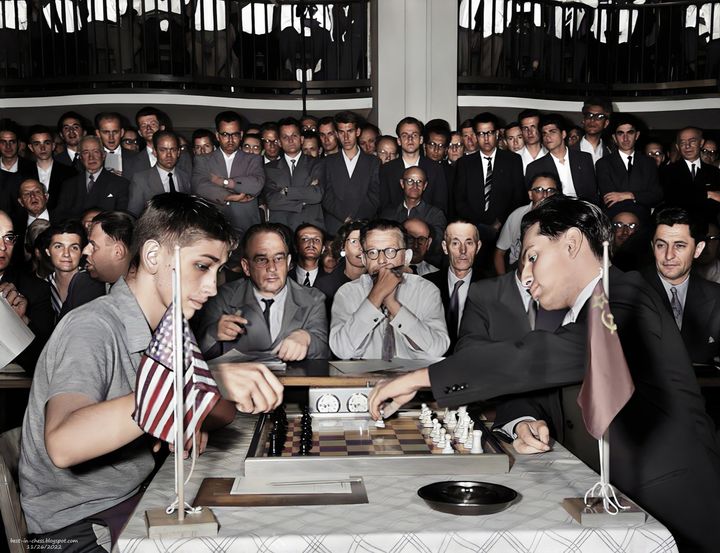
Fascinating footage from the start of this second game shows Tal, seeking to make fun of Fischer’s struggles with the Caro Kann, push his c-pawn to c6 and briefly pause before pushing it one square further to c5 to start a Sicilian. He flashes Fischer a mischievous grin which is unreturned by his younger opponent, who head rested on hand, sullenly ignores him and writes down the move. Tal recounted another psychological trick played on Fischer in the fourth game:
However, in our game Fischer first wrote down the move 22.Rae1!, without a doubt the strongest, and wrote it not in his usual English notation but in European, almost Russian! Then he not very deftly pushed the scoresheet towards me. 'He's asking for an endorsement', I thought to myself, but how was I to react? To frown was impossible, if I smiled he would suspect 'trickery', so I did the natural thing. I got up and began to calmly walk up and down the stage. I met Petrosian, made some joke to him, and he replied. The 15-year-old (sic) Fischer, who was essentially still only a large child, sat with a confused expression on his face, looking first at the front row of spectators where his second was sitting, and then at me. Then he wrote down another move. 22.Qc6?, and after 22...Rd7 23.Rae1+ Be7 24.Rxf7 Kxf7 25.Qe6+ Kf8! 26.Qxd7 Qd6 I held on to my extra piece and adjourned the game in a won position. When I later asked Fischer why he hadn't played 22.Rae1, he replied: 'Well, you laughed when I wrote it down!'
When the tournament had over, Fischer had finished sixth from eight and had lost all four encounters with Tal. It was a bruising experience for the sixteen-year-old. It was not until five years later that Fischer was able to joke to about it: ‘I thought I was better than Tal, but it was hard to convince anyone else after he had beaten me four times.’
Watch Tal troll Fischer here: (https://www.youtube.com/watch?v=vRkp0n0UUKg)
